

The Smithsonian’s National Museum of Natural History recently acquired three contemporary pieces of Caddo pottery from well-known modern Native American artist, Jeri Redcorn.
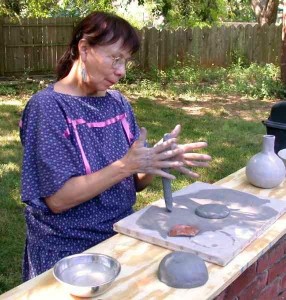
Image left: Caddo potter Jeri Redcorn
“One of the greatest strengths of the anthropology collections at NMNH is their historical depth,” says Daniel Rogers, anthropology department chairman at the Natural History Museum. “Ms. Redcorn’s contemporary pottery is providing NMNH anthropologists with a modern connection to early Caddo traditions.”
The Caddo people of Arkansas, Louisiana, Texas and Oklahoma have maintained many of their traditional ways and actively work to preserve their unique tribal cultural today. One example is the pottery of Jeri Redcorn.
“Ms. Redcorn’s pottery represents the modern reflection of a tradition that goes back more than 1,200 years,” says Rogers.
Redcorn, a native of Oklahoma, began her study of the legendary Caddo pottery after many years of admiring the work of her native people. In 1991, she vowed to learn how to carry on the tradition and officially began her study of the Caddo pottery.
Early Caddo pottery was made of coiled clay commonly mixed with a temper (a material that strengthens the clay) made of bone or pottery shards. The shape of the vessels varied considerably in form and decoration, but as seen in Redcorn’s work, pottery was commonly decorated with incised (drawn into wet clay) lines forming complex circular and rectangular designs that covered a large portion of the vessel.
Image right: These three vessels by Jeri Redcorn were recently added to the collections of the Anthropology Department of the National Museum of Natural History. (Photo by James DiLoreto)
In 2007 Ms. Redcorn was commissioned to make three pots for the National Museum of Natural History. The end result was three beautiful examples that represent a combination of traditional designs with a modern interpretation. The three pots were brought to the Smithsonian in 2009. Ms. Redcorn has also participated in the Smithsonian’s National Museum of the American Indian programs and in 2009 First Lady Michelle Obama chose one of Ms. Redcorn’s pots for display in the White House.
“Ms. Redcorn is a modern-day cultural interpreter of a very long tradition,” says Rogers, “We’re happy to have Ms. Redcorn’s pottery join the Smithsonian collection.”--Jessica Porter
You might also like:
 New Acquisition: FluMist “live” vaccine enters Smithsonian collections
 New Acquisition: Eighty-thousand bark beetles enter National Museum of Natural History collections
 NEW ACQUISITION: Remains of William Taylor White () donated to Smithsonian with his coffin and clothing
 John Marshall Ju/’hoan Bushman Film and Video Collection added to UNESCO register


