Archive | astrophysics

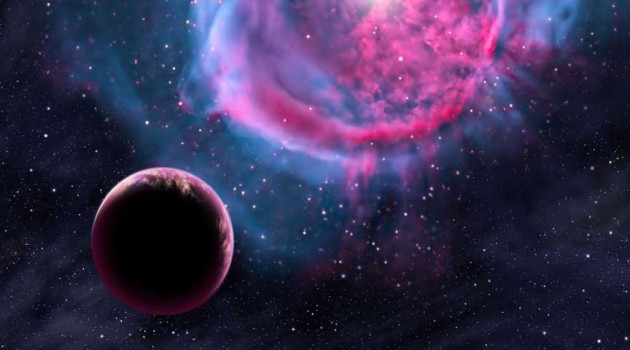
Unseen planet’s gravity allows Kepler Telescope to “see” it

Unseen planet’s gravity allows Kepler Telescope to “see” it

Researchers led by David Nesvorny of Southwest Research Institute and David Kipping of the Harvard-Smithsonian Center for Astrophysics has inferred an unseen planet, this time orbiting a distant star, marking the first success of this technique outside the solar system. [...more]

Research Topics, astrophysics Comments (0)

One supernova type, two different sources

One supernova type, two different sources

Two very different models explain the possible origin of Type Ia supernovae, and different studies support each model. New evidence shows that both models are correct - some of these supernovae are created one way and some the other. [...more]

Featured, astrophysics Comments (0)

Scientists catch black hole in a feeding frenzy

Scientists catch black hole in a feeding frenzy

Supermassive black holes snack infrequently, making the recent discovery of a black hole in the act of feeding all the more exciting to astronomers. [...more]

Featured, astrophysics Comments (1)

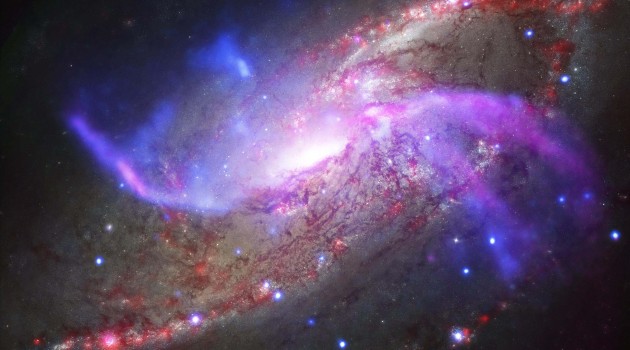
Astronomers witness black hole outburst in Spiral Galaxy M83

Astronomers witness black hole outburst in Spiral Galaxy M83

An extraordinary outburst produced by a black hole in a nearby galaxy has provided direct evidence for a population of old, volatile stellar black holes. [...more]

Featured, astrophysics Comments (0)

New image of the star-forming region 30 Doradus, also known as the Tarantula Nebula

New image of the star-forming region 30 Doradus, also known as the Tarantula Nebula

To celebrate its 22nd anniversary in orbit, the Hubble Space Telescope has released a dramatic new image of the star-forming region 30 Doradus, also known as the Tarantula Nebula because its glowing filaments resemble spider legs. 30 Doradus is located in the neighboring galaxy called the Large Magellanic Cloud, and is one of the largest [...] [...more]

Science Spotlight, astrophysics Comments (1)

Top 10 gallery celebrates the Infrared Array Camera aboard the Spitzer Space Telescope

Top 10 gallery celebrates the Infrared Array Camera aboard the Spitzer Space Telescope

For the last 1,000 days the Infrared Array Camera, aboard NASA’s Spitzer Space Telescope, has been operating continuously to probe the universe from its most distant regions to our local solar neighborhood. [...more]

astrophysics Comments (0)

Video: Take a glimpse into the Smithsonian’s new meteorite storage facility

Video: Take a glimpse into the Smithsonian’s new meteorite storage facility

Don your clean room clothing and take a glimpse into the Smithsonian's new Antarctic meteorite storage facility in Suitland, Md., where all of the Antarctic meteorites in the national collection are kept under tight security and tight airlocks. [...more]

astrophysics Comments (0)

Steady diet of binary star partners makes black holes grow “supermassive”

Steady diet of binary star partners makes black holes grow “supermassive”

A new study by astrophysicists at the University of Utah and the Smithsonian Astrophysical Observatory in Cambridge, Mass., has found a new explanation for the growth of supermassive black holes: they repeatedly capture and swallow single stars from pairs of stars that get too close. [...more]

astrophysics Comments (0)

Meet our Scientists—Videos!

Science Spotlight

Scientists from the Smithsonian Migratory Bird Center have found that fledgling catbirds living in the suburbs are extremely vulnerable. Almost 80 percent are killed by predators before they reach adulthood. Nearly half of the deaths are connected to domestic cats. The team studied catbird nests in 3 suburban neighborhoods in Maryland: Spring Park, Opal Daniels Park, and Bethesda. Learn more about this 2011 study by clicking here. (Catbird photo by Gerhard Hofmann)

Science Spotlight Archives