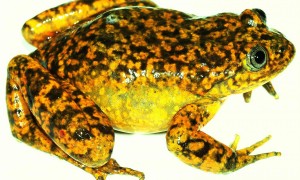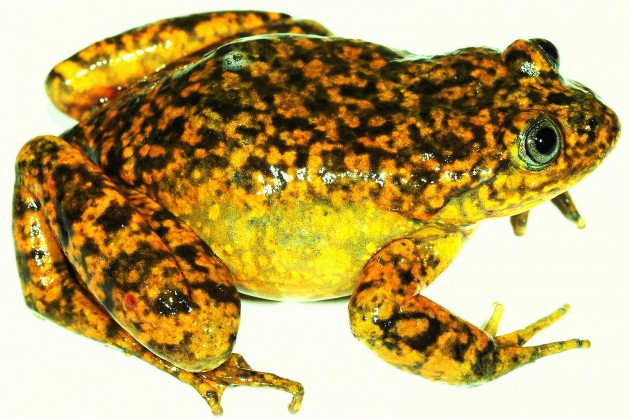
“Telmatobius ventriflavum,” a new water frog from the Pacific slopes of the Andes in central Peru.
A new water frog from the Pacific slopes of the Andes in central Peru has been described and named in the open access journal . Telmatobius ventriflavum was discovered during a 2012 survey for the Biodiversity and Monitoring Assessment Program of the Smithsonian Conservation Biology Institute’s Center for Conservation Education and Sustainability.
The name of this new species comes from the Latin venter, meaning belly, and flavus, meaning yellow and refers to the golden yellow and orange coloration of the frog’s body.
The Telmatobiinae, water frogs, are a subfamily of frogs endemic to the Andes of South America. The populations of several species of Telmatobius have declined dramatically over the past 30 years, and the genus is now thought to be extinct in Ecuador. These declines have been associated with the spread of the fungal disease chytridiomycosis.
Telmatobius ventriflavum was discovered in the species-poor coastal valleys of central Peru, a region well studied but apparently still hiding surprises.
“The discovery of a new species in such arid and easily accessible environments shows that much remains to be done to document amphibian diversity in the Andes.” comments the lead author of the study Dr. Alessandro Catenazzi of Southern Illinois Univeristy, Carbondale.
The study detected the presence of the chytrid fungus, but the impact of chytridiomycosis on the new species is unknown. The authors recommend disease surveillance to prevent outbreaks that might endanger the survival of this endemic species.
–Pensoft Publishers